

Read Our Reviews on:


The strongest finance functions do not choose between automation, AI, and people. They assign each one the work it is best equipped to do and build controls around the handoffs.
When the close is slow, reporting is fragmented, and team capacity is stretched, “AI” can become shorthand for modernization. But the CFO’s decision should not begin with a tool. It should begin with the work that needs to improve, the business outcome required, and the level of judgment and control the process demands.
Automation and artificial intelligence are related, but they are not interchangeable. Automation executes defined logic. AI works with patterns and probabilities. Used together and supported by skilled finance professionals, they can reduce manual effort, surface exceptions earlier, and create more capacity for analysis and decision support.
The distinction matters because applying the wrong technology to the wrong problem creates more complexity, not less. A rule-based workflow cannot interpret every unusual transaction. An AI model should not be trusted to approve a payment or post an entry simply because it can produce a plausible recommendation.
Key Takeaways for Finance Leaders
- Use automation for repeatable work with stable rules, inputs, and control points.
- Use AI to classify, predict, detect anomalies, and draft—especially when data is variable or unstructured.
- Design the workflow before selecting the tool; weak processes and poor data do not become reliable because AI is added.
- Keep accountable people in the loop for postings, reconciliations, payments, judgments, and external or client-facing outputs.
- Measure net value after review, correction, implementation, and control costs—not just gross time saved.
AI vs. automation in Accounting: The Difference at a Glance
A practical way to separate the two is to ask whether the work follows a known rule or requires the system to interpret uncertainty.
| Decision Lens | Automation | Artificial Intelligence |
|---|---|---|
| Operating logic | Executes defined rules, triggers, and workflows | Uses models to classify, predict, detect patterns, or generate content |
| Best fit | Stable, repeatable, high-volume work with clear inputs and outputs | Variable, unstructured, or pattern-rich work where context matters |
| Typical output | A task completed, routed, recorded, matched, or scheduled | A prediction, classification, anomaly, recommendation, or draft |
| Predictability | Usually deterministic when inputs and rules are controlled | Probabilistic; outputs can vary and may be wrong |
| Primary controls | Access rights, configured rules, approvals, logs, and exception routing | Data governance, validation, monitoring, source traceability, and human review |
This is not a contest between old and new technology. Most high-value finance workflows need both: automation to move the process forward consistently, AI to help interpret data and exceptions, and people to exercise judgment and accountability.
What is Accounting Automation?
Accounting automation uses configured rules, integrations, triggers, and workflows to complete predictable work. Its operating logic is essentially: when a defined event occurs, perform a defined action.
Common examples include:
- Moving approved data between systems on a schedule;
- Validating required fields and routing invoices for approval;
- Matching transactions that fall within defined thresholds;
- Assigning close tasks, sending reminders, and escalating overdue items; and
- Refreshing dashboards after source data has been updated.
The value of automation is consistency. When a process is standardized and the rules are sound, automation can reduce rekeying, enforce sequence, and create a clearer record of who did what and when. Its limitation is also clear: automation is only as good as the rules and exceptions built into the process.
It can route an invoice that exceeds a threshold, but it cannot always understand the commercial context behind an unusual charge. It can refresh a report, but it cannot determine whether management’s assumptions remain reasonable.

What is AI in accounting?
AI applies models to recognize patterns, classify information, generate content, or estimate likely outcomes. Unlike conventional automation, AI can work with variability, for example, different invoice formats, inconsistent descriptions, unusual transaction patterns, or narrative financial data.
Potential accounting and finance use cases include:
- Extracting and classifying information from invoices, receipts, contracts, and supporting documents;
- Identifying anomalies, duplicates, or transactions that merit further review;
- Supporting forecasts by analyzing historical and current drivers;
- Summarizing large volumes of financial or operational information; and
- Drafting variance commentary, management-reporting narratives, or first-pass explanations for review.
AI can extend the reach of a lean finance team, but its output is probabilistic rather than inherently correct. Models can misclassify data, overlook context, or generate explanations that sound confident without being supported. That makes validation, source traceability, access controls, and human review part of the operating design- not optional checks added later.
Why Finance Teams Increasingly Need Both AI and Automation
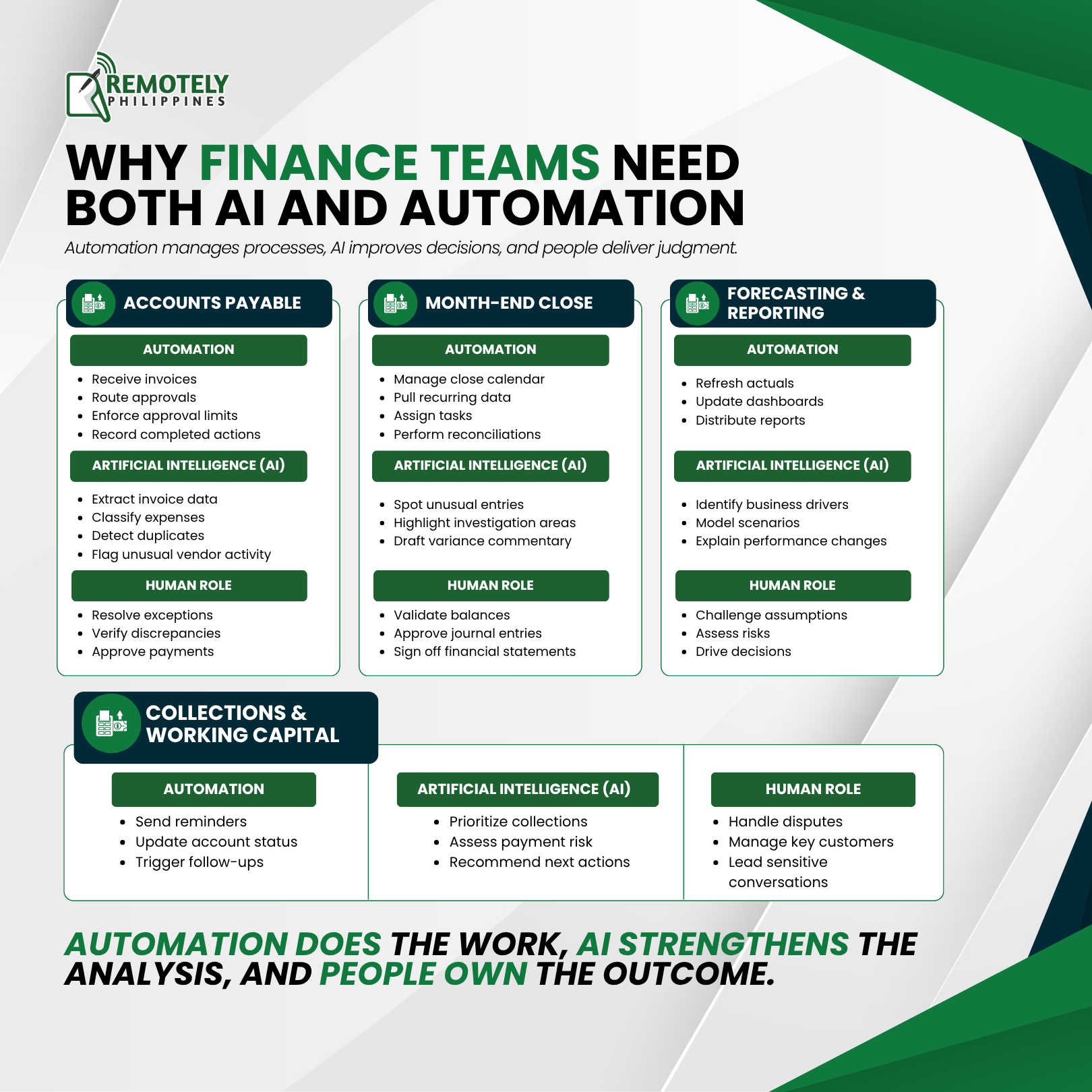
The distinction becomes most useful when it is applied to an end-to-end workflow. Consider four common finance processes.
- Accounts Payable
Automation can receive invoices, route approvals, enforce approval limits, and record completed actions. AI can extract fields from different document layouts, classify expenses, and flag duplicates or unusual vendor behavior. A finance professional still verifies exceptions, resolves discrepancies, and authorizes payment according to policy.
- Month-end Close
Automation can manage the close calendar, pull recurring data, assign tasks, and perform defined reconciliations. AI can surface unusual entries, suggest where investigation is needed, and draft preliminary variance commentary. The controller remains responsible for validating balances, approving entries, and determining whether the financial statements are ready to release.
- Forecasting and Management Reporting
Automation can refresh actuals, update dashboards, and distribute scheduled reports. AI can help identify driver relationships, model scenarios, and draft explanations of performance changes. Finance leadership must still challenge assumptions, understand model limitations, and decide what management should do next.
- Collections and Working Capital
Automation can send reminders, update statuses, and trigger follow-up workflows. AI can help prioritize accounts based on payment behavior or risk signals. People remain essential when the issue involves a disputed invoice, a strategic customer, or a commercially sensitive conversation.
These examples reflect what current finance practitioners are seeing: technology can accelerate data-heavy work, but clean data, shared definitions, internal controls, and team buy-in remain prerequisites.
Real-world finance implementations reported in the Journal of Accountancy show that AI can streamline difficult data work while still requiring formulas, reconciliations, and established controls to verify the results.
A 6-Step CFO Framework for Deciding What to Automate
A disciplined sequence helps finance leaders avoid two common traps: automating a broken process and applying AI where the risk exceeds the value.
- Start with the business outcome.
Define what should be improved and which guardrail must not deteriorate. “Reduce close cycle time without increasing unreconciled differences” is a stronger objective than “use AI in the close.” - Map the workflow and decision rights.
Separate deterministic tasks, exception-heavy work, professional judgment, and formal authorization. Document who owns each handoff and what evidence is required. - Strengthen the foundation.
Standardize definitions, clean critical data, confirm access rights, and remove unnecessary process variation. Technology will scale inconsistency if the operating foundation is weak. - Automate the stable core first.
Use conventional automation for work that is repeatable, rules-based, and easy to test. This creates reliable process data and clearer exception paths. - Add AI to a contained and high-value bottleneck.
Pilot one use case where classification, anomaly detection, forecasting, or drafting can materially improve the workflow. Use controlled data and define acceptance criteria before launch. - Measure net value and govern the lifecycle.
Track cycle time, touch time, exception rate, errors, rework, control incidents, adoption, and cost. Continue monitoring after deployment as data, models, vendors, and business conditions change.
The control question: where must a person remain accountable?
In finance, speed is useful only when the output can still be trusted. Governance should therefore be designed around risk, not around a blanket rule that every AI output receives the same level of review.

The NIST AI Risk Management Framework treats governance as a continuous responsibility across the AI lifecycle. It emphasizes clear accountability, documented roles, ongoing monitoring, and defined human oversight.
For a finance function, that translates into practical controls such as:
- A named business owner for the use case, data, and output;
- Approved tools, access rights, retention rules, and data-use boundaries;
- Risk-tiered review, with human authorization for postings, reconciliations, payments, judgments, and external outputs;
- Testing against known cases, including edge cases and failure scenarios;
- Logs, source traceability, version records, and documented exception handling; and
- A fallback process when the system, integration, or model is unavailable or unreliable.
The objective is not to keep people performing every manual step. It is to preserve accountable judgment at the points where an error could affect the books, cash, compliance, stakeholders, or management decisions.
What Should Finance Leaders Measure?
Technology investments should be evaluated as operating-model changes. A credible business case measures both efficiency and trust.
- Cycle Time: elapsed time from process start to an approved, usable output.
- Touch Time: active staff time required, including review and correction.
- Quality: error, exception, rework, and false-positive or false-negative rates.
- Control Performance: approval compliance, segregation of duties, access exceptions, and audit-trail completeness.
- Capacity Created: time shifted from processing to analysis, forecasting, advisory, or stakeholder support.
- Economics: licenses, integration, training, maintenance, review, correction, and vendor costs—not just gross hours saved.
- Adoption and Resilience: actual user uptake, process continuity, and performance under changes in inputs or business conditions.
A 2025 Intuit QuickBooks survey of 700 U.S. accounting professionals found that firms were prioritizing both AI and automation investment, while also reporting integration, training, and technology-stack complexity as persistent challenges.
The lesson for CFOs is straightforward: adoption is not the same as value. Integration, standardization, and user capability determine whether the investment improves the finance function.
A practical decision rule is to choose the technology based on the work.
- If the same input should reliably produce the same action, start with automation.
- If the work involves unstructured data, variable language, patterns, or estimates, consider AI with defined review.
- If the workflow spans execution, exceptions, judgment, and approval, combine automation and AI—and make human accountability explicit.
Technology is only one layer of the finance operating model. A modern finance function needs more than software. It needs clean data, disciplined workflows, clear ownership, skilled professionals, and a management cadence that turns financial information into action.
Frequently Asked Questions (FAQs)
-
1. Is automation the same as AI in accounting?List Item 1
No. Automation follows configured rules to execute repeatable work. AI uses models to classify, predict, detect patterns, or generate content. Many finance workflows use both.
-
2. Which should a CFO implement first: AI or automation?List Item 3
Start with the process, not the category. Standardize the workflow and automate stable, rules-based work first. Add AI where variability, unstructured data, or analytical bottlenecks justify it.
-
3. Can AI make accounting decisions without human review?List Item 4
Some low-risk outputs may need only light validation, but material finance actions should have review proportionate to risk. Postings, reconciliations, payments, judgments, and external reporting should retain accountable human authorization.
-
4. What accounting processes are good candidates for automation?
Accounts payable routing, recurring data transfers, transaction matching within thresholds, close-task management, scheduled reporting, and standard approval workflows are common candidates when rules and exceptions are well defined.
-
5. How can AI and automation improve month-end close?
Automation can coordinate tasks, move data, and perform defined reconciliations. AI can identify unusual items and draft preliminary explanations. The controller still validates balances, resolves exceptions, and approves the final output.
Conclusion
The debate between AI and automation in accounting is not about choosing one over the other. For CFOs, the real opportunity lies in understanding where each technology delivers the greatest value and how they can work together within a well-governed finance operating model.
Automation excels at executing repeatable, rules-based processes consistently, while AI helps finance teams interpret complex data, identify patterns, and support decision-making in situations where variability exists.
Organizations that achieve the strongest outcomes start by improving processes, strengthening data quality, and clarifying accountability before introducing new technology. Automation creates efficiency and consistency, AI adds intelligence and analytical capability, and finance professionals provide the judgment, oversight, and business context that technology cannot replace.
Ultimately, successful finance transformation is measured not by how much AI or automation is deployed, but by whether the finance function becomes faster, more accurate, more resilient, and better equipped to support strategic business decisions.
The most effective CFOs will not view AI and automation as competing solutions. They will treat them as complementary tools, supported by strong controls and skilled people, to build a finance organization that can scale with confidence.
Sign up for our newsletter
Get regular curated content on management, outsourcing, and everything you need to know to stay ahead of the curve.
Newsletter
More Articles