Read Our Reviews on:


How do finance teams maintain accuracy, accountability, and operational efficiency when people are no longer working in the same room?
Remote and hybrid work have permanently changed the way finance and accounting teams operate. What began as a temporary adjustment has evolved into a long-term operating model for many organizations.
Today, distributed finance teams manage everything from reconciliations and reporting to compliance and financial analysis across different locations and time zones. In this environment, technical accounting expertise alone is no longer enough.
High-performing remote finance teams also rely heavily on soft skills that support coordination, accuracy, and operational stability. Furthermore, they are also founded on these three key pillars, which are communication, accountability, and adaptability.
Communication keeps workflows aligned. Accountability ensures responsibilities are executed without constant oversight. Adaptability allows teams to respond effectively to changing systems, regulations, and business demands. For finance leaders, these skills are no longer considered “nice to have.” They are operational requirements that directly influence reporting quality, turnaround times, and team performance.
This article explores why communication, accountability, and adaptability have become critical pillars of modern remote finance teams and how organizations can intentionally strengthen these capabilities to build more resilient operations.
Key Takeaways
- Understand how soft skills directly influence financial accuracy, workflow efficiency, and collaboration in remote environments.
- Recognize the most common communication and coordination challenges faced by distributed finance teams.
- Identify practical strategies that strengthen communication, accountability, and adaptability across remote operations.
- Understand why finance organizations must balance technical expertise with interpersonal and operational competencies.
- Apply these principles to create more resilient, productive, and scalable finance teams.
The Growing Value of Remote Finance Teams
Remote finance teams are no longer viewed as experimental or temporary structures. Across the accounting and finance sector, flexible work arrangements have become a standard component of modern operations.
Advancements in cloud accounting platforms, workflow automation, collaboration software, and digital reporting systems now allow finance professionals to perform complex tasks efficiently from virtually anywhere. Activities that once depended heavily on in-office coordination, such as month-end close management, reconciliations, approvals, and financial reporting, can now be handled through integrated digital systems.
Industry data reflects this shift clearly. Recent reports show that approximately 82% of finance firms have already adopted hybrid or remote work arrangements. At the same time, nearly 65% of finance professionals prefer flexible work setups for at least part of their workweek.
These trends indicate that remote work is no longer simply an employee preference. It has become a major factor in talent attraction, retention, and long-term workforce planning. Beyond employee satisfaction, organizations are also seeing operational advantages.
Studies indicate that around 52% of finance firms experienced productivity improvements after implementing remote work structures. Many organizations reported stronger focus, improved efficiency, and better task ownership among employees working in flexible environments.
Reduced commuting time, fewer workplace interruptions, and greater autonomy have all contributed to these outcomes. More broadly, research across knowledge-based industries continues to show that remote professionals often maintain or exceed previous productivity levels when supported by the right systems and processes.
For finance leaders, the discussion has therefore shifted. The question is no longer whether remote finance teams can work effectively. The more important question is how organizations can structure distributed teams to maintain accuracy, compliance, visibility, and operational consistency.
This is where soft skills become operationally critical. Communication, accountability, and adaptability enable distributed finance teams to function cohesively despite physical distance. Without these capabilities, even technically skilled teams can struggle with delays, workflow breakdowns, duplicated effort, and reporting risks.
Why Communication Matters in Remote Finance Teams
In traditional office settings, finance teams often rely on quick conversations, informal clarifications, and spontaneous collaboration to resolve issues quickly. Questions can be answered immediately across desks or during hallway discussions.
Remote environments remove much of that informal interaction. As a result, communication must become significantly more intentional, structured, and documented. For finance and accounting teams, this is especially important because small misunderstandings can create major downstream consequences.
Misinterpreted instructions, unclear approvals, or incomplete documentation can lead to reconciliation issues, reporting delays, compliance gaps, or audit complications. Strong communication practices help reduce these operational risks.
The Importance of Documentation
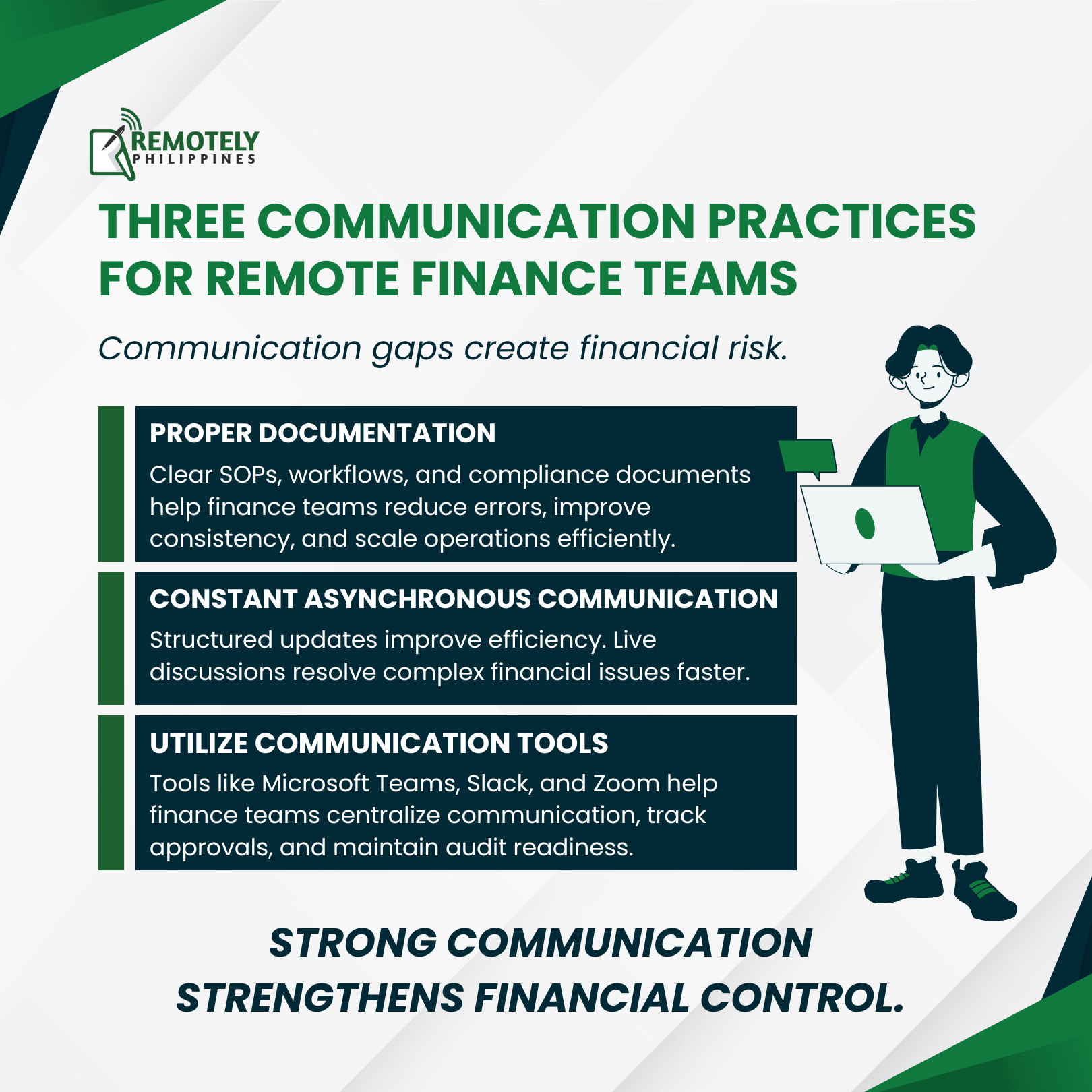
One of the most important communication practices in remote finance operations is proper documentation. Distributed teams rely heavily on written procedures, standardized workflows, shared files, and documented financial processes to ensure consistency across the organization.
When information is centralized and accessible, employees can work with greater clarity and fewer assumptions. Documentation creates a “single source of truth” for the team.
This includes:
- Standard operating procedures (SOPs)
- Reporting guidelines
- Approval workflows
- Reconciliation processes
- Compliance checklists
- Internal control documentation
Well-maintained documentation reduces confusion, improves onboarding, and helps teams execute tasks more consistently, especially during high-volume reporting periods. It also minimizes operational dependency on specific individuals, which is critical for scalability and continuity.
Balancing Asynchronous and Real-Time Communication
Remote finance teams also need to balance different communication methods effectively. Asynchronous communication allows employees to review updates, complete tasks, and respond within structured timelines without requiring everyone to be online simultaneously.
Shared documents, project management systems, workflow trackers, and collaboration platforms all support this approach. This flexibility is particularly useful for distributed teams operating across different schedules or time zones.
However, asynchronous communication alone is not always sufficient. Complex financial discussions, reporting concerns, or compliance-related issues often require real-time conversations to prevent misunderstandings and delays.
Video meetings and live discussions remain essential for handling nuanced topics that need immediate clarification. High-performing remote finance teams understand when to use each method. They avoid excessive meetings while still creating opportunities for alignment, clarification, and collaboration when needed.
Communication Tools That Support Finance Operations
Modern finance teams now rely heavily on digital collaboration tools to maintain visibility and coordination. Communication tools such as Microsoft Teams, Slack, and Zoom help teams communicate quickly and efficiently, while project management systems improve workflow tracking and deadline visibility.
When used properly, these tools help:
- Reduce miscommunication
- Improve task visibility
- Centralize discussions
- Maintain audit trails
- Improve turnaround times
- Increase operational transparency
More importantly, strong communication systems help employees clearly understand expectations, responsibilities, and priorities, which naturally strengthens the next critical pillar of remote finance operations: accountability.
Accountability in a Remote Finance Environment
While communication keeps workflows connected, accountability ensures that work is completed accurately, consistently, and on time. In remote finance environments, accountability becomes even more important because direct supervision is naturally reduced.
Managers cannot rely on physical visibility to monitor progress. Instead, organizations must build systems and cultures that encourage ownership and responsibility. For finance professionals, accountability is directly tied to operational reliability.
Missed deadlines, incomplete reconciliations, delayed approvals, or reporting inaccuracies can significantly impact financial operations and decision-making. Strong accountability helps prevent these breakdowns.

Ownership Without Micromanagement
One of the defining characteristics of high-performing remote finance teams is the ability to operate with autonomy. Finance professionals who understand how their work impacts broader financial operations are more likely to take ownership of tasks and maintain high-quality outputs without constant oversight.
This includes:
- Managing deadlines independently
- Escalating issues early
- Maintaining reporting accuracy
- Following documented procedures
- Providing proactive updates
Organizations that over-rely on micromanagement often create operational friction and reduce employee trust. In contrast, teams that combine clear expectations with professional autonomy tend to perform more efficiently. Accountability works best when employees understand both their responsibilities and the business impact of their work.
Strengthening Internal Controls and Workflow Visibility
Accountability also depends heavily on operational structure. Clear role definitions, standardized workflows, and well-designed internal controls help remote finance teams maintain consistency and transparency. When responsibilities are clearly assigned, organizations can:
- Track workflow progress more effectively
- Identify delays earlier
- Reduce duplicated effort
- Strengthen reporting accuracy
- Improve compliance oversight
Workflow visibility is particularly important in remote environments where tasks move across multiple people or departments. Without proper systems, organizations risk creating bottlenecks, approval delays, and operational blind spots. Strong internal controls help maintain accountability without relying solely on managerial oversight.
Building Trust Across Distributed Teams
Trust is both a requirement and an outcome of accountability. When team members consistently meet deadlines, communicate proactively, and deliver accurate work, trust naturally develops across the organization. This trust improves collaboration and allows finance operations to run more smoothly, even during high-pressure reporting cycles.
In distributed environments, trust also reduces unnecessary follow-ups and operational friction. Teams that trust one another can focus more on execution and problem-solving instead of constantly monitoring progress. This foundation becomes especially valuable when organizations face rapid operational or regulatory changes, which brings us to the third pillar of remote finance success: adaptability.
Practical Ways to Strengthen Communication, Accountability, and Adaptability
Building these capabilities requires intentional effort from both finance leaders and team members. Here are several practical strategies organizations can implement to strengthen these core pillars in remote finance operations.

Establish Clear Communication Standards
Remote finance teams should define:
- Expected response times
- Preferred communication channels
- Escalation procedures
- Documentation standards
- Meeting cadences
Clear communication structures reduce confusion and improve operational consistency, especially during high-volume periods such as month-end close or audit preparation.
Implement Performance Visibility Systems
Organizations should use workflow tracking and performance management systems that improve transparency across remote teams. These systems help monitor:
- Task completion
- Reporting timelines
- Workflow bottlenecks
- Collaboration efficiency
- Deadline management
Operational visibility strengthens accountability while helping leaders identify risks before they impact financial operations.
Encourage Open Feedback and Collaboration
Regular check-ins and open discussions help teams address issues early before they become operational problems. A culture that encourages constructive feedback also improves psychological safety, making employees more comfortable raising concerns, admitting mistakes, or requesting support when needed.
This transparency strengthens both communication and accountability across the organization.
Invest in Ongoing Learning and Development
Continuous learning initiatives help finance professionals stay current with:
- Accounting standards
- Regulatory updates
- Emerging technologies
- Automation tools
- Operational best practices
Training investments also reinforce adaptability by helping employees build confidence in navigating change. Organizations that prioritize learning are typically better positioned to scale and evolve their finance operations over time.
FAQs
List of Services
-
1. Why are soft skills important in remote finance teams?List Item 1
Soft skills help finance professionals collaborate effectively in distributed environments. Strong communication, accountability, and adaptability improve workflow coordination, reporting accuracy, and operational efficiency.
-
2. What is the biggest communication challenge in remote finance operations?List Item 3
One of the biggest challenges is the lack of spontaneous in-person communication. Without clear systems and documentation, misunderstandings can lead to delays, reporting errors, or compliance risks.
-
3. How does accountability improve remote finance performance?List Item 4
Accountability ensures employees take ownership of tasks, meet deadlines, and maintain reporting accuracy without requiring constant supervision. This improves operational reliability and team trust.
-
4. Why is adaptability critical for finance professionals today?
Finance teams must continuously adjust to changing technologies, automation tools, compliance requirements, and reporting standards. Adaptability helps organizations remain efficient and resilient during change.
-
5. What tools support remote finance collaboration?
Many remote finance teams use platforms such as Microsoft Teams, Slack, and Zoom alongside cloud accounting systems like QuickBooks Online, NetSuite, and Xero to improve communication, workflow visibility, and operational efficiency.
Conclusion
As remote and hybrid work continue to reshape the accounting and finance industry, the definition of a high-performing finance team is evolving alongside it. Technical expertise remains essential, but operational success now depends just as heavily on soft skills that support collaboration, consistency, and resilience.
Communication helps distributed teams maintain alignment and accuracy. Accountability ensures responsibilities are executed reliably even without direct supervision. Adaptability enables finance professionals to navigate evolving technologies, workflows, and compliance requirements with confidence.
Together, these pillars create the foundation for sustainable remote finance operations. For finance leaders, strengthening these capabilities is no longer simply about improving workplace culture. It is a strategic investment in operational efficiency, reporting accuracy, scalability, and long-term business resilience.
Organizations that intentionally develop these skills within their finance teams will be better equipped to thrive in an increasingly digital and distributed financial environment.
Sign up for our newsletter
Get regular curated content on management, outsourcing, and everything you need to know to stay ahead of the curve.
Newsletter
More Articles