Turning Post-Tax Season Lessons into Smarter Processes
Ian Jerrick Inandan • July 6, 2026

Read Our Reviews on:

A red circle is floating in the air on a white background.
A white background with a few lines on it

The first real sign that busy season is over is not an empty inbox. It is the moment your team finally has enough room to ask a better question: 

What should never be this hard again next year?

For accounting and tax leaders, that question carries even greater weight in 2026. According to Thomson Reuters, efficiency is now the top strategic priority for 52% of tax professionals, while 40% report that their firms' capabilities are constrained or at risk because of talent shortages.


AICPA reporting also shows that the profession continues to face hiring challenges and a shrinking graduate pipeline, making process discipline just as critical as headcount. The firms and finance teams that emerge from busy seasons stronger do more than recover.


They turn the lessons they have learned into better tax season workflows, tighter accounting SOPs, clearer documentation standards, and cleaner handoffs across preparers, reviewers, and client-facing teams.


Rightworks' 2026 post-tax season research reinforces this point. Nearly half of firms reported a better tax season, yet 41% still described the season as overwhelming. The difference rarely comes down to effort alone. Instead, it reflects how work is designed, documented, and routed throughout the organization. 

Key Takeaways


  • Post-tax season process improvement works best when you translate stress points into updated SOPs, not just retrospective notes.
  • The biggest wins usually come from standardizing evidence, clarifying what “done” means, and narrowing the gray area between preparation and review.
  • Cleaner handoffs reduce rework, protect reviewer capacity, and improve governance during the next surge.
  • A dedicated offshore accounting team can provide execution capacity for SOP updates, documentation cleanup, and repeatable process support without pulling senior staff away from client work.
  • The goal is not only faster execution. It is a more scalable operating model with less burnout, stronger control, and more time for high-value advisory work.

Post-Tax Season Is the Right Time to Redesign, Not Just Recover


Busy season acts as a pressure test. It reveals where intake breaks down, approvals pile up, workpapers lack sufficient support, and too much progress depends on a handful of experienced people manually bridging process gaps. For that reason, the post-tax season window is one of the most valuable opportunities for improvement.


Rightworks recommends conducting a debrief shortly after the deadline, while lessons are still fresh. Its 2026 guidance also emphasizes optimizing workflows, creating action plans, and reviewing process documentation before the next cycle begins.


The broader market reinforces this urgency. Thomson Reuters reports that firms continue to face a chronic talent shortage, resulting in persistent overwork, skills gaps, and capacity constraints. The same report also notes that both business and individual clients increasingly expect tax professionals to serve as trusted advisors beyond compliance work.


As a result, firms need stronger processes for two reasons: to protect delivery capacity and to free senior talent to focus on higher-value advisory work. This is why post-tax season process improvement should be viewed as an operating model decision rather than a cleanup exercise. If your team documents what happened but fails to improve how work is received, routed, supported, and reviewed, the same friction will resurface when the next deadline arrives.

What to Update in Your Accounting SOPs After Busy Season

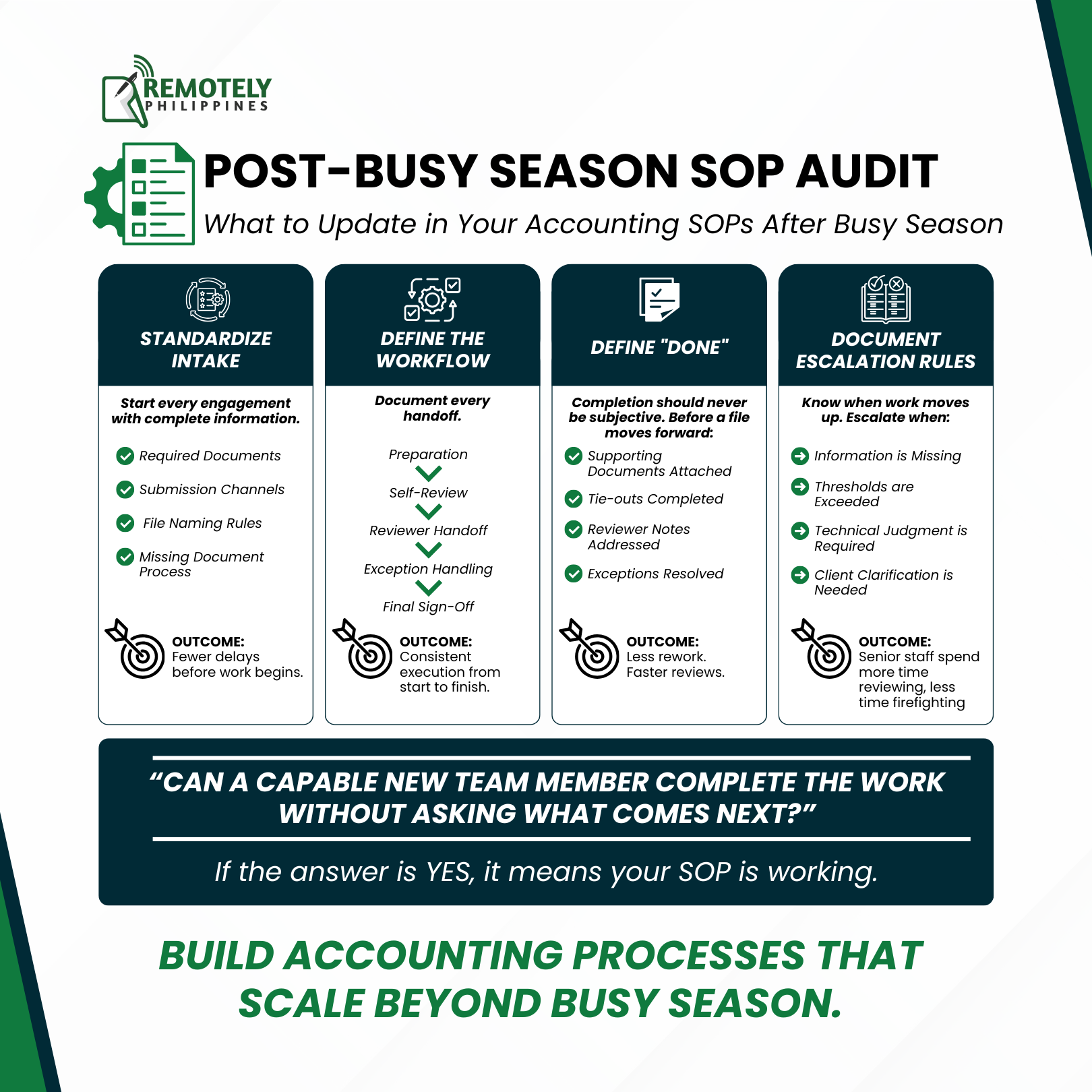
The most effective accounting SOPs are more than generic process documents. They are practical guides that reduce ambiguity when work is moving quickly and deadlines are tight. After the busy season, start by updating the areas that generated the most rework and created the biggest operational bottlenecks.

Standardize Intake Requirements


Define exactly what must be received before work begins, where documents should be submitted, and how incomplete submissions are identified and flagged. Many bottlenecks start upstream when files arrive through multiple channels, naming conventions are inconsistent, or critical source documents are missing.


Rightworks specifically recommends reviewing process documentation to identify steps that still rely on manual inputs, spreadsheet workarounds, or poorly structured client submissions.


Define the Workflow Stages


Every repeatable task should clearly outline what happens during preparation, self-review, reviewer handoff, exception handling, and final sign-off. 


Our recent blog on finance workflow redesign and the Definition of Done reinforces this principle: when "complete" is left to individual interpretation, revision loops become part of the normal workflow. Standardizing workflow stages makes completion measurable instead of assumed.


Write a Real Definition of Done 


For tax files and accounting workpapers, this means specifying the required supporting documents, tie-outs, reviewer notes, exception status, and source references before a file can move forward. This becomes even more important when work passes between different staff levels or across locations.


Remotely's April 2026 guidance on the Definition of Done emphasizes that clear completion criteria reduce ambiguity, improve accountability, and make outsourcing more reliable by ensuring everyone works toward the same standard. 


Document Escalation Rules


Your SOP should clearly define what happens when information is missing, whether thresholds are exceeded, or technical interpretation is required. Doing so keeps judgment-based work with the appropriate reviewers and prevents senior staff from spending valuable time on issues that should have been escalated earlier.


For firms committed to finance process optimization, the practical test is straightforward: if a capable new team member can follow the SOP without relying on tribal knowledge, then the document is doing exactly what it was designed to do.


Standardize Evidence and Clean Up Your Handoffs


If there is one lesson that almost every busy season reinforces, it is this: files do not move slowly because of volume alone. They slow down when supporting evidence is inconsistent and handoffs lack clarity.


  • Start with Standardized Evidence Requirements

    Every file should clearly show the source documents used, how figures were validated, what adjustments were made, and whether any open items remain. In tax and accounting environments, this typically includes consistent naming conventions, source linking, supporting documentation for adjustments, variance explanations, and a visible list of unresolved exceptions.

    Our blogs on tax file quality control and the
    Definition of Done reinforce the same operational principle: well-supported outputs reduce reviewer questions, shorten revision cycles, and improve audit readiness.


  • Strengthen Handoff Quality

    A good handoff is more than a file marked "finished and sent." It provides the next reviewer with enough context to continue the work without having to reconstruct the story from scratch. In practice, this means documenting the status of open items, reviewing notes that have already been addressed, items still awaiting client response, and a clear explanation of the decision or action expected from the next reviewer.

    When handoffs are incomplete, senior staff often become the link between systems, files, and conversations, spending valuable time filling information gaps instead of focusing on higher-value work. Our post-busy season workflow article highlights this challenge, noting that the real cost is not just overtime but also the rework caused by fragmented workflows and unclear transitions. The impact extends beyond individual teams. Fragmented systems continue to reduce capacity across the profession.


According to Intuit's 2026 Accountant Technology Survey, accountants spend approximately five hours each week moving, re-entering, or reconciling information across different tools, while 48% say their firm's technology environment remains fragmented despite still functioning.


These findings reinforce why standardized evidence and well-defined handoffs are far more than administrative best practices. They are practical ways to reduce avoidable work, improve review efficiency, and create smoother tax season workflows. 


Where an Offshore Accounting Team Fits Best


Outsourcing delivers the greatest value when it is treated as dedicated execution capacity within a well-defined operating model, rather than as a vague promise to simply "take work off the team." In 2026, that distinction is more important than ever, as firms work to improve processes while protecting the bandwidth of senior professionals.

Three coworkers collaborate at a desk in a modern office, reviewing a laptop and desktop monitor.

Thomson Reuters reports that firms are responding to talent constraints through training, automation, and selective outsourcing. Meanwhile, Intuit's 2026 survey found that 80% of firms already outsource at least one service, and 65% plan to expand their outsourcing efforts. This is where an offshore accounting team can provide the greatest value after the busy season.


Its role is not to replace reviewer judgment but to provide the structured execution capacity needed to update SOP packs, clean up task-level documentation, standardize workpaper support, maintain trackers, prepare recurring files, and keep process improvement initiatives moving while internal leaders remain focused on client work and technical decisions.


This approach aligns with our recent blog that process-driven work can be distributed safely when workflows, responsibilities, and controls are clearly defined, while approvals, technical interpretation, and advisory responsibilities remain in-house. A practical division of responsibilities typically looks like this.

Best suited for offshore execution capacity:


  • Recurring file preparation
  • Workpaper assembly
  • Checklist administration
  • Documentation standardization
  • Routine reconciliations
  • First-pass QC support
  • Status tracking
  • Client document follow-up
  • SOP pack maintenance

Best Kept In-house:


  • Workpaper assembly
  • Checklist administration
  • Documentation standardization
  • Routine reconciliations
  • First-pass QC support
  • Status tracking
  • Client document follow-up
  • SOP pack maintenance


This approach strengthens governance rather than compromising it. It also reflects the Philippines' position as one of the world's leading global services delivery destinations. According to IBPAP's industry roadmap, the country is one of the two largest IT-BPM delivery hubs globally and supports a wide range of non-voice business process services, including finance and accounting, through a large and highly skilled talent pool.


For firms exploring accounting outsourcing in the Philippines, that level of industry maturity matters because sustainable process improvement depends on reliable execution, not simply additional capacity. 


Keep Post-Tax Season Process Improvement Moving


The biggest risk after the busy season is not missing the lessons. It is losing momentum. Maintaining a governance cadence does not have to be complicated. Start with a debrief while the details are still fresh. Turn pain points into action items with clearly assigned owners. Prioritize the changes that will have the greatest impact on the next cycle, then review progress monthly until preparations for the next busy season begin.


Rightworks' 2026 debrief guidance supports this approach by recommending that firms distribute surveys first, assign an owner and deadline to every action item, and focus on fully implementing a small number of meaningful improvements instead of creating a long list of unfinished initiatives.


To measure progress, track a small set of process indicators that reflect whether the new operating model is working as intended. These may include first-pass review acceptance rates, reopened files, missing-support exceptions, turnaround time by workflow stage, and handoff-related questions raised during review.


People’s metrics deserve equal attention. Rather than measuring output alone, include indicators that reflect long-term sustainability. Burnout continues to be a significant challenge across the profession. 

People seated in a quiet office, working behind computer monitors and a glass partition.

Intuit's 2026 survey found that 90% of respondents reported fatigue and burnout as a major issue, while AICPA's firm survey and Thomson Reuters' research continue to identify staffing pressure and talent shortages as key factors affecting firm performance.


The long-term strategy is straightforward: don't wait for leadership capacity that may never materialize. Instead, establish a cadence that continuously improves accounting SOPs, evidence standards, and handoffs, even after senior staff return to client delivery.


This is one of the strongest operational arguments for a dedicated offshore accounting team in the Philippines. It allows firms to sustain process improvement without consuming the very leadership capacity they are trying to protect. 

Frequently Asked Questions (FAQs)

Conclusion


Post-tax season is when firms decide whether busy season will remain an annual scramble or become a valuable source of process intelligence. The smartest response is rarely dramatic; it is disciplined. Update your SOPs. Strengthen evidence requirements. Clarify what a complete handoff looks like. Deliberately separate execution from judgment, then give your team the capacity to sustain those improvements over time.


This is the true value of post-tax season process improvement. It creates more scalable workflows, reduces avoidable burnout, strengthens governance, and gives experienced professionals more time to focus on the work clients value most. In a market shaped by ongoing efficiency pressures, talent constraints, and rising client expectations, smarter processes are no longer a competitive advantage. They are the foundation of a resilient operating model.


If your firm is rethinking tax season workflows, rebuilding accounting SOPs, or exploring a dedicated offshore accounting team for sustainable finance process optimization, we can help. Remotely Philippines offers end-to-end accounting, assurance, advisory, and compliance solutions designed to help organizations scale with more control.


Book a consultation to discuss what a smarter post-busy season operating model could look like for your team.

Sign up for our newsletter


Get regular curated content on management, outsourcing, and everything you need to know to stay ahead of the curve.

Newsletter

More Articles

Hands typing on a laptop displaying analytics charts in a bright office setting
By Princess Cabangon June 23, 2026
Learn why accurate financial forecasting is essential for business growth, strategic planning, risk management, and stakeholder confidence.
Hands calculating finances with calculators, paperwork, pens, and a keyboard on a desk.
By Marvin Lester Negosa June 17, 2026
Learn how to build a safe and scalable offshore accounting team after the busy season, reduce burnout, and maintain quality, security, and control.
Person buried in paperwork holds a large clock in an office, conveying time pressure
By Marvin Lester Negosa June 4, 2026
Accounting and finance teams cannot rely on overtime alone during the busy season. Learn how stronger workflows create more scalable finance operations.
More Posts