
Read Our Reviews on:


Is your accounting team recovering from busy season, or simply preparing to survive the next one?
For many accounting firms and finance departments, busy season exposes operational issues that never truly disappear, such as capacity constraints, burnout, delayed processes, and increasing difficulty finding experienced talent. Busy season may be over, but the challenges it exposes often remain.
Many accounting firms and finance departments emerge from peak periods facing the same issues they had before deadlines arrived:
Exhausted teams, delayed processes, capacity constraints, and growing concerns about retention.
At the same time, hiring experienced accounting professionals has become increasingly difficult. As talent shortages continue to affect the profession, many organizations are realizing that adding local headcount alone is no longer a sustainable growth strategy.
Key Takeaways
- The accounting talent shortage is a long-term challenge that requires proactive capacity planning.
- The post-busy season period is the ideal time to build and integrate an offshore accounting team.
- Process-driven accounting functions can be safely outsourced when supported by documented procedures and strong oversight.
- Strategic decision-making, approvals, and client advisory responsibilities should remain in-house.
- Governance, security controls, and communication structures are essential for successful outsourcing.
- Offshore accounting teams help reduce burnout while creating scalable capacity for future growth.
According to industry surveys, accounting and finance leaders continue to rank talent acquisition and retention among their most significant operational challenges, with experienced accountants becoming increasingly difficult and expensive to hire.
As a result, firms are exploring new ways to build capacity without sacrificing quality, security, or control. One solution gaining momentum is the offshore accounting pod model.
Yet many leaders still have valid concerns. Will quality suffer? Can financial data remain secure? How do you maintain visibility and accountability across a distributed team?
The answer is not simply outsourcing. It is building the right framework. When properly structured, an offshore accounting team becomes an extension of your organization, helping reduce burnout, strengthen operational capacity, and support long-term growth.
Moving Beyond Emergency Staffing
Historically, many organizations approached offshoring as a temporary solution during periods of high demand. Additional resources were brought in during the busy season to complete data entry, process transactions, or support administrative tasks. Once workloads stabilized, the relationship often ended.
While this approach may provide short-term relief, it rarely delivers long-term operational improvement. Temporary staffing models often result in inconsistent quality, fragmented communication, and limited process ownership. Internal teams frequently spend more time reviewing and correcting work than they save through outsourcing.
A dedicated offshore pod operates differently. Instead of functioning as a temporary resource, the offshore team becomes an integrated part of your accounting and finance operation. They work within your systems, follow your procedures, and support your workflows on an ongoing basis.
This structure allows your internal professionals to spend less time on repetitive production work and more time on activities that directly contribute to business growth.
These may include:
- Client advisory services
- Financial planning and analysis
- Strategic decision-making
- Process improvement initiatives
- Relationship management
By building an offshore pod immediately after the busy season, organizations gain the time needed to document workflows, onboard talent, and establish operational consistency before the next peak period arrives.
The Safety Blueprint: What to Offshore and What to Keep In-House
One of the most common reasons outsourcing initiatives fail is a lack of role clarity. Organizations attempt to outsource responsibilities that require judgment, interpretation, or executive decision-making. This creates confusion, increases risk, and weakens accountability.
The most effective approach follows a simple principle: Offshore production. Retain the judgment and final approval. Execution, preparation, reconciliation, and processing can be delegated. Oversight, interpretation, approval, and decision-making should remain with internal leadership.
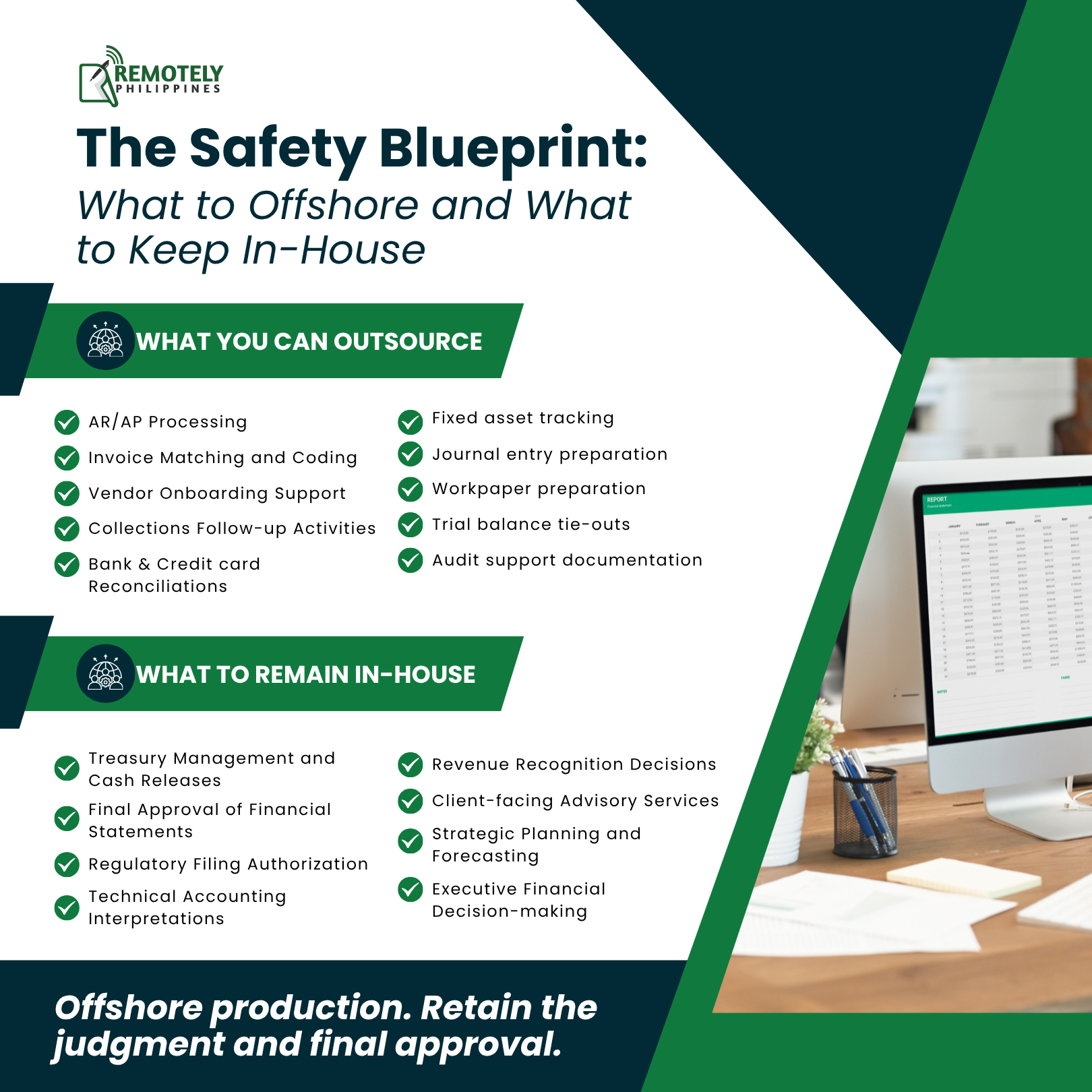
What Is Safe to Offshore?
Process-driven accounting tasks are often ideal for offshore support because they rely on documented procedures, consistency, and technical execution.
Examples include:
- Accounts payable and receivable processing
- Invoice matching and coding
- Vendor onboarding support
- Collections follow-up activities
- Bank and credit card reconciliations
- Fixed asset tracking
- Journal entry preparation
- Workpaper preparation
- Trial balance tie-outs
- Audit support documentation
These tasks are critical but also highly repeatable. With proper documentation and oversight, they can be performed efficiently by a dedicated offshore accounting team. For many organizations, moving these responsibilities offshore accelerates workflows while freeing internal staff to focus on more strategic priorities.
What Should Remain In-House?
Some responsibilities require deep business context, executive judgment, and direct stakeholder trust. These functions should remain under the control of your internal leadership team:
- Treasury management and cash releases
- Final approval of financial statements
- Regulatory filing authorization
- Technical accounting interpretations
- Revenue recognition decisions
- Client-facing advisory services
- Strategic planning and forecasting
- Executive financial decision-making
Maintaining this distinction allows organizations to expand capacity without compromising governance or accountability.
The Governance Checklist: What Must Exist Before Day One
Building an offshore accounting team without proper governance creates unnecessary risk. Before granting access to financial systems, organizations should establish a strong operational foundation. While these governance pillars are essential, organizations do not necessarily need to build them entirely from scratch.
Experienced accounting outsourcing providers often help clients establish workflow documentation, security controls, communication structures, and transition plans as part of the onboarding process. The most successful outsourcing relationships are built on a shared operating framework that allows offshore professionals to integrate seamlessly into existing accounting and finance operations.

Pillar 1: Clearly Defined Workflows and Responsibilities
A simple rule applies: If a process exists only in someone's head, it is not ready to be outsourced. Every workflow should be documented, standardized, and assigned clear ownership.
A common structure includes:
| Role | Primary Responsibility |
|---|---|
| Offshore Team | Preparation and Processing |
| Onshore Team | Review and Quality Assurance |
| Leadership | Final Approval and Oversight |
This separation creates accountability while ensuring critical decisions remain under internal control. For organizations that are new to outsourcing, experienced accounting outsourcing partners can often assist with process mapping, responsibility matrices, workflow documentation, and transition planning before work is handed off.
Pillar 2: Strong Security and Access Controls
Data security remains one of the most common concerns associated with outsourcing. However, security depends less on geography and more on infrastructure, controls, and governance. Organizations should work with outsourcing partners that maintain strong security standards and operate within secure cloud environments.
Key safeguards include:
- Multi-factor authentication (MFA)
- Role-based system permissions
- Secure virtual desktop environments
- Restricted file downloads
- Device management controls
- SOC 2-aligned controls and security practices
Financial data should remain within secure systems and should never be stored on personal devices. Established outsourcing providers typically operate within secure environments and can help clients implement the controls necessary to support compliance, data protection, and operational continuity.
Pillar 3: Structured Communication Processes
Equally important is operational visibility. Organizations should maintain access to workflow dashboards, task trackers, reconciliation statuses, and performance metrics. Effective outsourcing should increase visibility into accounting operations, not reduce it.
Even highly skilled professionals struggle when communication is inconsistent.
Organizations should establish:
- Daily operational touchpoints
- Weekly alignment meetings
- Defined escalation procedures
- Performance reporting expectations
- Designated points of contact
A structured communication framework helps maintain accountability while ensuring questions are resolved quickly. Many accounting outsourcing partners also bring proven communication and performance management frameworks that help offshore teams integrate effectively with onshore staff.
Frequently Asked Questions (FAQs)
-
1. How do we maintain quality when working with an offshore accounting team?List Item 1
Quality is maintained through documented workflows, clear accountability, and structured review processes. Offshore professionals’ complete preparation and processing work, while internal teams retain review and approval responsibilities.
-
2. Will outsourcing compromise data security?List Item 3
Not when proper controls are in place. Secure cloud environments, multi-factor authentication, role-based permissions, and SOC 2-aligned security practices help protect sensitive financial information.
-
3. When is the best time to build an offshore accounting team?List Item 4
The period immediately after busy season is often ideal because workloads are more manageable, giving organizations time to document processes, onboard team members, and establish workflows before the next peak cycle.
-
4. Does outsourcing replace internal employees?
No. The purpose of an offshore pod is to strengthen your existing team. By taking ownership of process-driven work, offshore professionals allow internal staff to focus on higher-value responsibilities that require experience, judgment, and client interaction.
How Offshore Accounting Teams Help Break the Burnout Cycle
Many organizations evaluate outsourcing primarily through the lens of cost savings. While cost efficiency can certainly be a benefit, it is rarely the most valuable outcome. The real advantage is sustainable capacity.
A dedicated offshore accounting team enables handling growing workloads without continually placing additional pressure on internal employees. Instead of asking your team to work longer hours every busy season, you create a support structure designed to absorb operational demands while maintaining quality and consistency.
This allows accounting and finance professionals to focus on activities that generate greater value for clients and stakeholders. It also helps address one of the most expensive challenges teams experience during busy season: burnout and turnover. When experienced professionals can focus on meaningful work rather than administrative overload, retention often improves alongside productivity.
The result is a healthier operating model that supports both performance and employee well-being. In other words, outsourcing is not simply about doing work more efficiently. It is about creating an environment where your best people can perform at their highest level.
Conclusion: Turn Recovery Time into Growth Time
Busy season should not leave your accounting and finance team trapped in a cycle of exhaustion and recovery. The most successful firms use the post-busy season period to strengthen their operating model before the next surge in demand arrives. A dedicated offshore accounting team is not simply a staffing solution; it is an operating model.
It is a strategic way to build capacity, improve operational consistency, and create a more sustainable workload for your internal team. With the right governance, security controls, and communication framework in place, outsourcing becomes a powerful tool for growth, allowing accounting and finance leaders to focus less on capacity constraints and more on serving clients, supporting stakeholders, and driving long-term business success.
For organizations looking to scale without compromising quality or control, the post-busy season window may be the best opportunity to build a stronger foundation for the future.
Sign up for our newsletter
Get regular curated content on management, outsourcing, and everything you need to know to stay ahead of the curve.
Newsletter
More Articles